
RevengeIdeas
Served Cold
Their master was forced to kill himself over an insult. His samurai waited almost two years — playing the part of broken, drunken failures — before they struck.
By the start of the eighteenth century, Japan had been at peace for nearly a hundred years. The Tokugawa shogunate, established in 1603 after the wars that unified the country, had imposed an order so rigid that an entire warrior class found itself with very little warring left to do. The samurai were still the ruling caste, bound by the code later romanticised as bushidō, but their swords had grown largely ceremonial. Their world was now one of stipends, etiquette, and the elaborate protocol of the shogun's court at Edo, the city we now call Tokyo. This created a peculiar tension. A samurai's identity rested on loyalty to his lord and on a willingness to die rather than suffer dishonour, yet the conditions that once tested such loyalty had all but vanished. Honour had become a matter of ritual rather than the battlefield. The case of the forty-seven rōnin endures partly because it was the rare moment when the old ferocity broke through the lacquered surface of the peace, and the whole society was forced to decide what it actually believed about the values it claimed to hold. The lords who governed the provinces, the daimyō, were required to spend long stretches in Edo and to perform precise duties when summoned to the shogun's castle. Ignorance of court ceremony could humiliate a man before his peers and his sovereign. So when a young provincial lord was ordered to help receive imperial envoys in the spring of 1701, the stakes were not military but social — and in that world, social ruin could be the more fatal of the two.
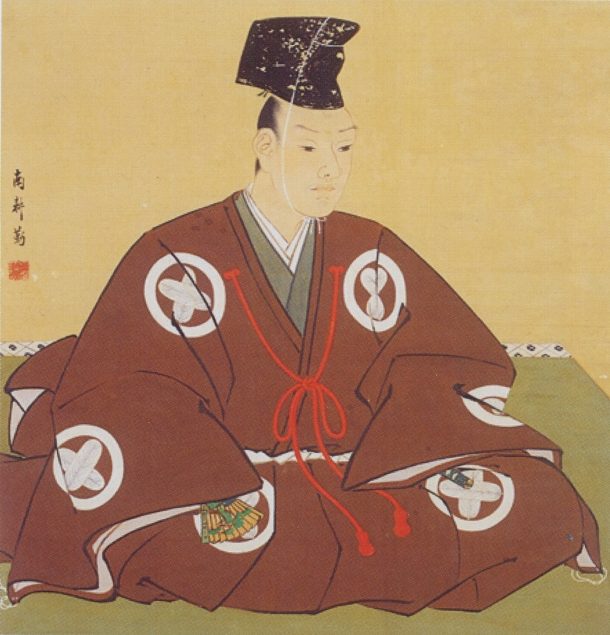
The lord was Asano Naganori, daimyō of Akō, a domain in what is now Hyōgo Prefecture. He was perhaps thirty-five, and largely unschooled in the niceties of the capital. To guide him through the reception of the envoys, the shogunate appointed Kira Yoshinaka, also read Kira Kōzuke-no-suke, a high-ranking master of court protocol whose business it was to instruct provincial lords in their duties. What passed between the two men is not recorded with certainty, and this is where the history must be honest about its gaps. By the most repeated account, Kira treated Asano with open contempt — mocking his manners, withholding the guidance he was owed, and, in some tellings, doing so because Asano had failed to offer the customary gifts and bribes that smoothed such relationships. Whether Kira was a genuine villain or merely a proud official who found the country lord tiresome, we cannot fully know. What is certain is that on the twenty-first day of the third month of 1701, in a corridor of Edo Castle itself, Asano drew a short sword and struck at Kira, wounding him on the face and shoulder before he was restrained. Asano is said to have cried out as he attacked, though the exact words vary by source. The act itself was what mattered, and it was catastrophic. To draw a weapon within the shogun's castle was an absolute crime, regardless of provocation. The fifth shogun, Tokugawa Tsunayoshi, ruled within hours. Asano was condemned to commit seppuku, ritual suicide, that very day. He did so in a borrowed garden, and by tradition composed a death poem before opening his belly. Kira, the man who had provoked him, was not punished at all.
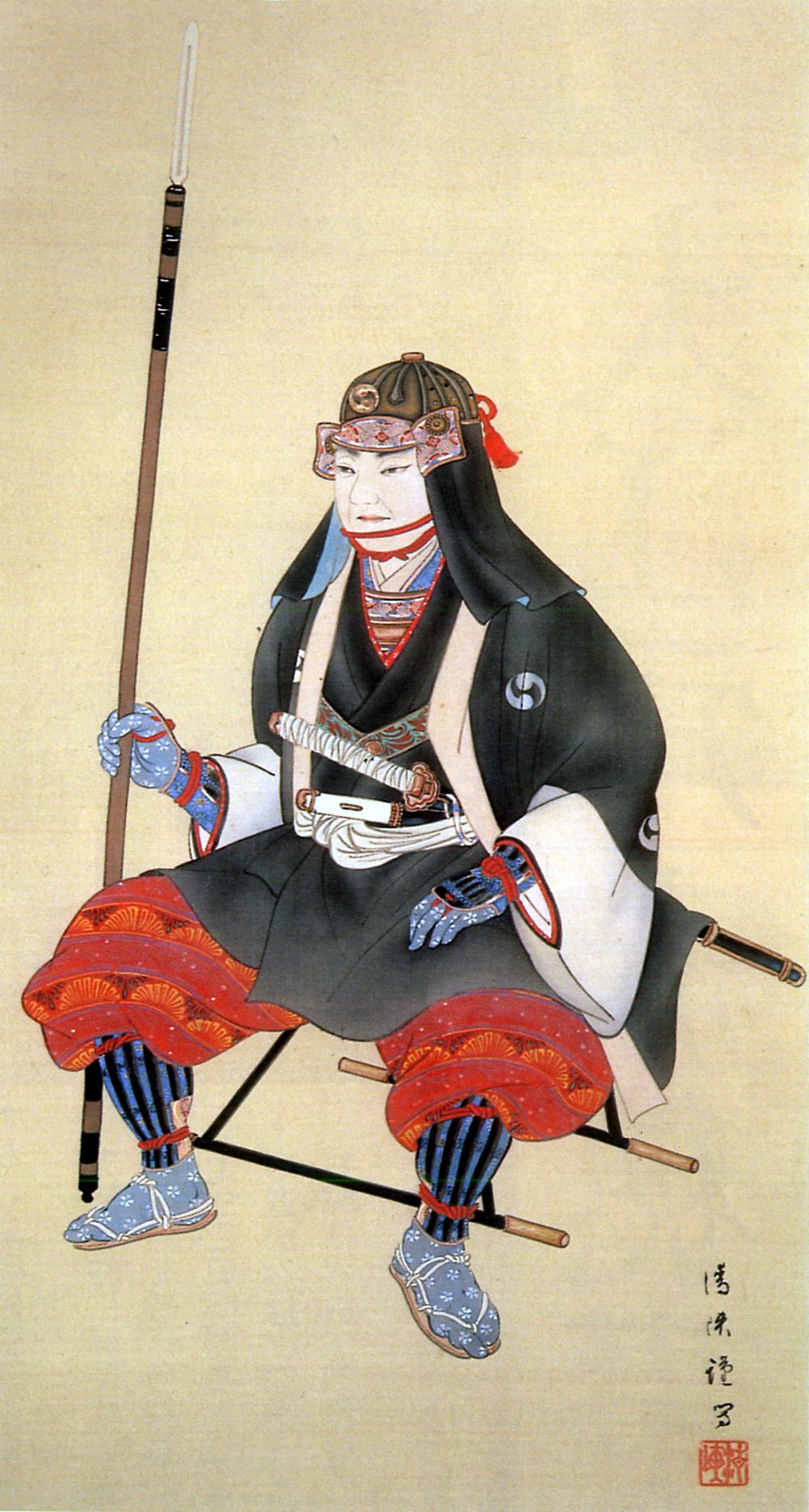
The judgement carried consequences far beyond one man's death. With Asano's seppuku, his domain of Akō was confiscated, his family line suspended, and his retainers — more than three hundred samurai — stripped of their lord, their stipends, and their place in the world in a single stroke. They became rōnin: masterless samurai, a word that literally means 'wave men', drifting without anchor. What galled the most loyal among them was not merely the loss but the asymmetry of the verdict. Their lord had died and his house had been destroyed, while the official who provoked him walked free, his rank intact. The shogunate's principle of kenka ryōseibai — that both parties in a quarrel should share the blame — had been applied to only one side. To men raised on the idea that a samurai's first duty was to his lord, the conclusion was inescapable: justice had not been done, and it fell to them to do it. The senior retainer of Akō, the man who held the castle and the household accounts, was Ōishi Kuranosuke Yoshio. It was he who took charge of the dissolution — surrendering the castle peacefully to the shogunate's officers rather than dying in a futile last stand, settling the domain's affairs, and quietly gathering around him those retainers who shared his resolve. From the original three hundred, the circle of the committed narrowed to a few dozen who swore a secret oath: they would avenge their master by killing Kira, whatever it cost them.
Here the story earns its place. Kira was no fool. He knew that Asano's men had reason to want him dead, and he fortified himself accordingly — strengthening his mansion in Edo, retaining guards, and keeping watch for any sign that the rōnin were plotting. The shogunate's agents watched too. A clumsy, immediate strike would have failed and been crushed. So Ōishi chose patience, and patience of a particularly humiliating kind. He let the conspirators scatter. Some took work as tradesmen and labourers, hiding in plain sight across Edo and beyond. Ōishi himself moved to Kyoto and, by the account that has come down to us, gave himself over to a public display of dissolution — drinking, frequenting the pleasure quarters, abandoning every appearance of a man with purpose. He is said to have separated from his wife to spare her family the consequences of what was coming. The performance was meant to reach Kira's spies, and it did. The most famous anecdote, often retold and impossible to verify, has a man from Satsuma find Ōishi lying drunk in a Kyoto street and spit on him, disgusted that a samurai could fall so low and leave his lord unavenged. If the tale is embellished, it captures the strategy exactly: Ōishi wanted to be despised, because a despised man is not feared. Beneath the act, the work was meticulous. The rōnin gathered intelligence on Kira's household, the layout of his mansion, the number and habits of his guards, and the routine of the compound. One of them is said to have married into the family of the builder who had constructed the mansion in order to obtain its plans. They smuggled in weapons. They waited for Kira's vigilance to relax, and across nearly two years it did — convinced by the rōnin's apparent collapse that no revenge was coming, he reduced his guard. Only when the moment was right did Ōishi summon the conspirators back to Edo.
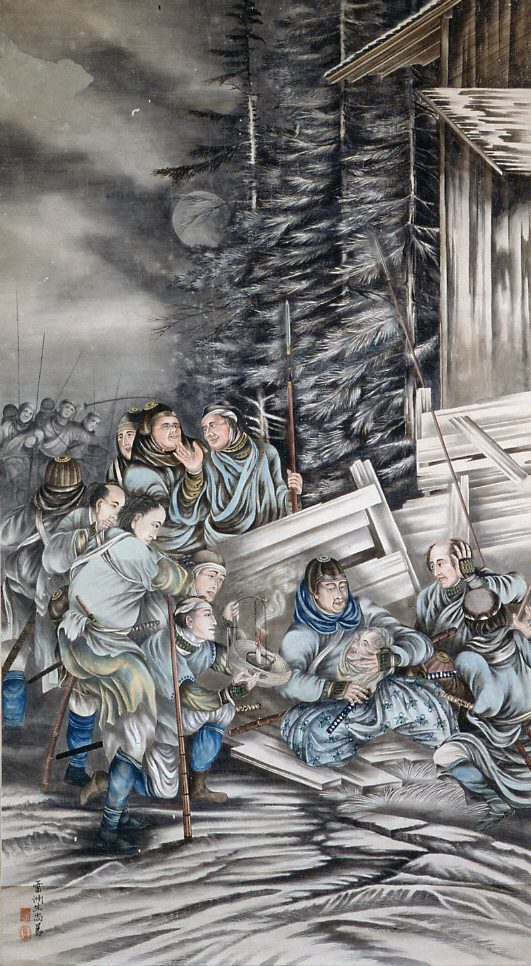
On the night of the fourteenth day of the twelfth month of 1702 — by the Western calendar, the early hours of 31 January 1703 — forty-seven men gathered in secret in Edo. Snow lay on the ground. They had divided into two parties to assault Kira's mansion from front and rear simultaneously, and before they struck, Ōishi is said to have sent word to the neighbouring houses explaining that they were retainers avenging their lord, not bandits or rebels, so that the neighbours would not be alarmed or intervene. It was an act of discipline characteristic of the whole enterprise: even in vengeance, they observed a kind of order. They broke in, overwhelmed the guards, and fought through the household. The assault was fierce; a number of Kira's men were killed and many wounded, while the rōnin took losses though, remarkably, none were killed outright in the fighting by most accounts. Kira was not in his bed. The attackers found his bedding still warm, searched the compound, and at last discovered him hidden in an outbuilding — by the common account a charcoal shed or storeroom — cowering with two retainers, in his nightclothes. Ōishi, recognising the scar on his face from Asano's blow, identified the old man. According to the chronicles, the rōnin treated him with formal courtesy even then: they explained who they were and why they had come, and offered Kira the chance to die honourably by his own hand, presenting him the very dagger with which Asano had committed seppuku. Kira could not, or would not, answer. Ōishi then killed him. They severed his head, extinguished the lamps and fires in the mansion so as not to start a blaze among the neighbouring houses, and departed into the snow at dawn with their grim trophy.
They walked across Edo in the early morning, a column of armed men carrying the head of a senior official, and the city watched. They went to Sengaku-ji, the temple where Asano Naganori was buried. There they washed Kira's head in a well — the well is still shown to visitors today — and laid it upon their lord's grave, reporting to the dead man that his enemy had at last been brought to justice. Then they waited, having already sent notice to the authorities of what they had done. They did not run. This was the heart of their dilemma, and they understood it perfectly. They had fulfilled the highest demand of loyalty — avenging their lord — but in doing so they had broken the shogun's law against vendetta and against assembling armed men to commit murder. The two duties could not be reconciled. The shogunate debated the case for weeks. The public, and a good many officials, openly admired the rōnin; their loyalty was precisely the virtue the regime claimed to prize. Yet to pardon them would be to license private vengeance against the state's monopoly on justice. Confucian scholars of the day argued both sides, and the argument over whether the verdict was right would continue for centuries. The compromise the shogunate reached was, in its way, an acknowledgement of their honour. Rather than executing them as common criminals, the men were sentenced to commit seppuku — the death of a samurai, not a felon. On the fourth day of the second month of 1703, forty-six of the rōnin took their own lives. They were buried at Sengaku-ji, beside the master they had avenged. The forty-seventh, the youngest, had by most accounts been sent away to carry the news home, and was spared; he is said to have lived on for decades and was eventually buried with his comrades when he died.
The story passed almost immediately from history into legend. Within decades it was dramatised for the stage, most enduringly in the puppet and kabuki play Kanadehon Chūshingura — 'The Treasury of Loyal Retainers' — first staged in 1748. To evade the shogunate's ban on depicting recent political events, the playwrights moved the action to an earlier era and changed the names, but everyone knew exactly whose tale was being told. Chūshingura became one of the most popular works in the Japanese theatre, endlessly reworked for stage, woodblock print, film and television, and it carried the legend far beyond the facts, adding incidents and speeches that the historical record never recorded. Because so much of what most people 'know' about the forty-seven rōnin comes from drama rather than document, historians have long warned that the line between event and embellishment is blurred. The number forty-seven, the broad shape of the insult, the long deception and the winter raid are well attested; many of the celebrated details — the spitting in the street, the exact words exchanged, the dagger offered to Kira — survive through repetition and theatre as much as through hard evidence. This is one of those revenges where the legend has grown around a true core, and the honest telling keeps the two apart.
What the centuries fixed upon was not the violence of the single night but the discipline of the years that led to it. The raid lasted a couple of hours; the revenge took the better part of two years, most of it spent doing nothing that looked like courage at all — drinking, lying low, accepting contempt, waiting. The forty-seven rōnin became Japan's enduring parable of loyalty precisely because their vengeance demanded the suppression of every honourable instinct until the one moment it could be satisfied. The ambiguity has never quite resolved, and perhaps that is why the story refuses to die. They were criminals by the law of their own state and heroes by its deepest values, and the shogunate's solution — letting them die as samurai rather than felons — was less a verdict than an admission that the two things could both be true at once. The graves at Sengaku-ji became, and remain, a place of pilgrimage. Visitors come, the incense smoke rises, and what draws them is not the bloodshed but the waiting — the men who proved that the deadliest patience is the kind that lets the world believe you have given up.
Image: Yasuda Raishū, "Reward for the 47 Rōnin" (Homma Museum of Art). Public domain.
Their graves at Sengaku-ji temple still draw visitors who burn incense for them. Centuries later, the patience is what people remember.

They killed her husband, then sent ambassadors to ask her to marry their prince. She welcomed them warmly — and erased their entire people in four escalating acts of horror.
Kidnapped and held for ransom, the young Caesar told his captors exactly what he would do to them once freed. They thought it was a joke. It was not a joke.