
RevengeIdeas
Served Cold
They killed her husband, then sent ambassadors to ask her to marry their prince. She welcomed them warmly — and erased their entire people in four escalating acts of horror.
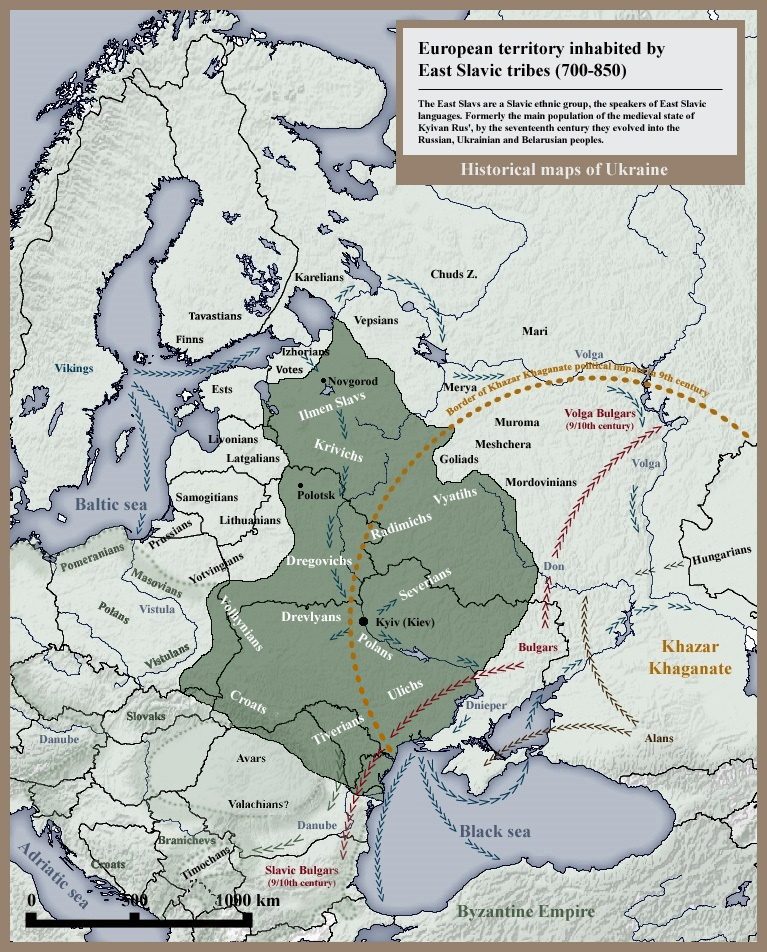
In the middle of the tenth century, the lands that would one day be called Russia were not a state in any modern sense but a loose and violent confederation of Slavic and Finnic tribes, knitted together by a ruling class of Norse origin known as the Rus'. They had come down the great river roads — the Dnieper, the Volga — as traders and raiders, and by the 940s their princes ruled from Kiev, a fortified town on a bluff above the river that served as the gathering point for the furs, honey, wax and slaves that flowed south to the markets of Constantinople. Power in this world was personal and extractive. A prince was a war-leader who guaranteed protection in exchange for tribute, and his authority extended exactly as far as his armed retinue, the druzhina, could ride. Among the tribes subject to Kiev were the Drevlians, a Slavic people whose name derives from the word for forest and who lived in the wooded country to the west of the Dnieper, around their chief town of Iskorosten (modern Korosten in Ukraine). The Drevlians were close kin to the Kievan Polians, and that very closeness made them dangerous: they had their own princes, their own warbands, and a long memory of having paid tribute under duress. Our chief source for what followed is the Povest' vremennykh let, the Primary Chronicle, compiled in Kiev in the early twelfth century and traditionally associated with the monk Nestor. It was written down generations after the events it describes, drawing on oral tradition, and the modern reader is right to treat its precise dialogue and its tidy fourfold structure as the shaping of memory into story. But the bones of the account — a prince killed, a widow's terrible answer — are old, and the chroniclers told them as sober history.
The ruler of Kiev was Igor, son of Rurik, a prince of the Rurikid line whose reign the chronicles place across the first half of the tenth century. His wife was Olga, a woman of Pskov of probable Varangian descent, whose strength of character the chronicle takes care to establish before the catastrophe that defined her. In the year 945, according to the Primary Chronicle, Igor went out to collect tribute from the Drevlians. Having taken his due, he was persuaded by the greed of his retinue, who complained that they went in rags while the prince grew rich, to turn back and demand a second payment from the same people. It was an act of plain extortion, and the Drevlians understood it as such. Their prince, named in the chronicle as Mal, put the matter to his council in terms that have the cold logic of the steppe frontier: if a wolf comes among the sheep, he said, he will carry off the whole flock unless he is killed; so it is with Igor, who will destroy us all if we do not destroy him first. The Drevlians sallied out from Iskorosten and fell upon Igor and the small party that remained with him. The Byzantine historian Leo the Deacon, writing later in the tenth century, preserves a detail the Kievan chronicle does not: that Igor was taken alive, bent between two bowed birch trees that were then released, and torn in two. Whether by that gruesome method or a simpler one, Igor was dead, and the Drevlians had killed a prince of Kiev. The question was what came next, and here the Drevlians made the error that would annihilate them: they imagined they had won.
Olga was now a widow, and her son Sviatoslav was a small child, too young to lead a warband. To the Drevlian leadership this looked less like a crisis than an opportunity. Their prince Mal resolved to marry the widow, absorb Kiev's authority into his own line, and dispose of the boy heir at leisure. It was, on its face, a shrewd political stroke — conquest by wedding rather than war. The Drevlians dispatched twenty of their most distinguished men, boyars and elders, rowing up the Dnieper to Kiev to make the proposal: their prince was a good man, they said, better than the Igor who had bled them; let Olga take him as husband. They had murdered Igor, and now they came openly to court his widow over his unburied corpse. By the customs of the day this was not subtlety but contempt, and Olga met it with a courtesy so warm it should have frightened them.
Olga received the embassy graciously. She told the ambassadors that their words pleased her, that her husband could not be brought back, and that she wished to do them great honour before her people the following morning. When they returned to their boat for the night, she instructed them on the form that honour would take: her men, she said, would not lead them on horseback nor on foot, but would carry them to her court in their very boat, lifted high. The Drevlians, flattered, agreed. At dawn Olga's men hoisted the boat with the ambassadors sitting proudly inside it — and tipped it into a deep trench that had been dug overnight within the palace bounds. Olga leaned over the edge and asked whether the honour pleased them. Then she had them buried alive, earth and all, while they were still in the boat. She had not finished. Before word of the first embassy's fate could travel, Olga sent a message to the Drevlians: if they truly wished her to come to their prince, they must send a still grander deputation, their finest men, or the people of Kiev would not let her go. The Drevlians, knowing nothing of the trench, obliged at once and sent their leading men. Olga welcomed this second party and offered them a bath-house in which to refresh themselves after their journey, a gesture of high hospitality in the Rus' world. The Drevlians went in to wash. Olga's people barred the doors from outside and set the bath-house alight, and every man within burned to death. Two embassies of the Drevlian nobility had now been swallowed by the earth and the fire, and the Drevlians at home still believed their suit was prospering.
Olga then sent word ahead that she was at last coming to the Drevlian country to marry their prince, and that they should prepare great quantities of mead at the place where Igor had been killed, so that she might first weep over her husband's grave and hold the funeral feast that custom demanded. The Drevlians gathered the mead and assembled in number. Olga came to Iskorosten with a small company, mourned at the burial mound, and then bade her followers serve the Drevlians and drink with them. When the Drevlians, deep in their cups, asked where the splendid embassies they had sent to Kiev had gone, Olga answered that they were following behind with her husband's bodyguard. At her signal her retinue fell upon the drunken, defenceless crowd. The chronicle gives the number cut down at the feast as five thousand. Olga then returned to Kiev to raise an army, for the killing of the leadership and the slaughter at the feast were, by her reckoning, only the prelude.
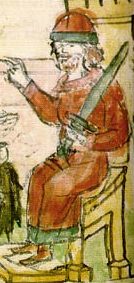
In 946 Olga led her host into the land of the Drevlians, her young son Sviatoslav riding at its head as the nominal commander; the chronicle records that the boy cast the first spear, which fell short between his horse's ears, and that the captains took it as the signal to advance because the prince had opened the battle. The Drevlians were beaten in the field and shut themselves up behind the walls of Iskorosten, the very town from which Mal had ordered Igor's death. There they held out through the summer, for the place was strong and Olga could not take it by storm. So she took it by guile, in the fourth and final act of her vengeance. Olga sent into the town a message of feigned mercy. She had already had her revenge thrice over, she let them believe; now she wished only for a token submission and would lift the siege. She asked of them a tribute so trifling it seemed a joke: three pigeons and three sparrows from each household. The relieved townsfolk gathered the birds gladly and handed them over. Olga distributed the birds among her soldiers with orders to bind to the leg of each a scrap of sulphur or smouldering tinder wrapped in cloth. At nightfall the birds were released, and each flew home to its nest in the eaves and dovecotes and thatch of Iskorosten. The whole town caught fire at once, from every quarter, so that there was no part of it that was not burning and nowhere to flee. The Drevlians who ran out were cut down or taken; some Olga killed, some she gave into slavery to her followers, and the remainder she left alive to pay a heavy tribute. Iskorosten was ash, the Drevlian polity was broken, and the people who had thought to inherit Kiev by murdering its prince had been erased as an independent power.
The vengeance, ferocious as it was, served a cold political end as well as a personal one. With the Drevlians crushed and her son still a child, Olga ruled as regent of the Kievan Rus' for the better part of two decades, and the chronicles credit her with a far-sighted reorganisation of the very system whose abuses had killed her husband. She travelled through the subject lands and fixed tribute at set amounts, established administrative centres and collection points known as pogosty, and divided the territory into districts. The arbitrary second-helping extortion that had cost Igor his life was replaced by something closer to regular taxation — a state, in embryo, rather than a season of raiding. The woman remembered for the bath-house and the burning birds was also, by the chronicle's own account, the first ruler of the Rus' to govern the realm as an institution rather than a hunting ground.
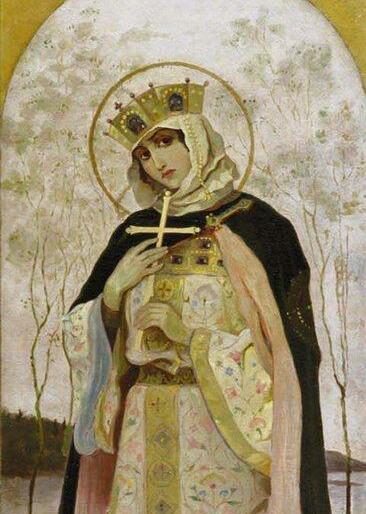
Around the year 957 Olga travelled to Constantinople and was received at the court of the emperor Constantine VII Porphyrogenitus, who left in his own work on court ceremonies a sober record of the receptions held for the princess of the Rus'. There, by the Kievan tradition, she was baptised a Christian, taking the name Helena after the reigning empress, and became the first ruler of the Rus' to accept the new faith. The conversion did not take among her people in her lifetime; her son Sviatoslav remained a pagan warrior to the end, and it would fall to her grandson Vladimir, in 988, to convert the Rus' as a whole. But Olga had planted the seed, and the Orthodox Church remembered her for it. She died in 969 and was in time canonised, venerated as Equal-to-the-Apostles, a title reserved for those who brought whole nations to the faith — the same honour later granted to her grandson Vladimir. The chronicle that records her sainthood is the very chronicle that records the trench, the bath-house, the funeral feast and the incendiary pigeons, and it sees no contradiction in this: the burning of the Drevlians belonged to her old life, the baptism to her new one. Modern historians read the four acts with proper caution — the symmetry of pagan funeral rites perverted into instruments of death has the shape of legend, and the sparrows in particular wander through a great deal of medieval folklore. Yet the Primary Chronicle gives Olga's revenge in plain narrative as the thing that founded her authority, and it is as that grimly methodical widow, far more than as the gentle convert, that the centuries have remembered Saint Olga of Kiev.
Image: Mikhail Nesterov, "Saint Olga" (1892). Public domain, via Wikimedia Commons.
Olga later converted to Christianity and was canonised as a saint. Patron, one can only assume, of the very long memory.
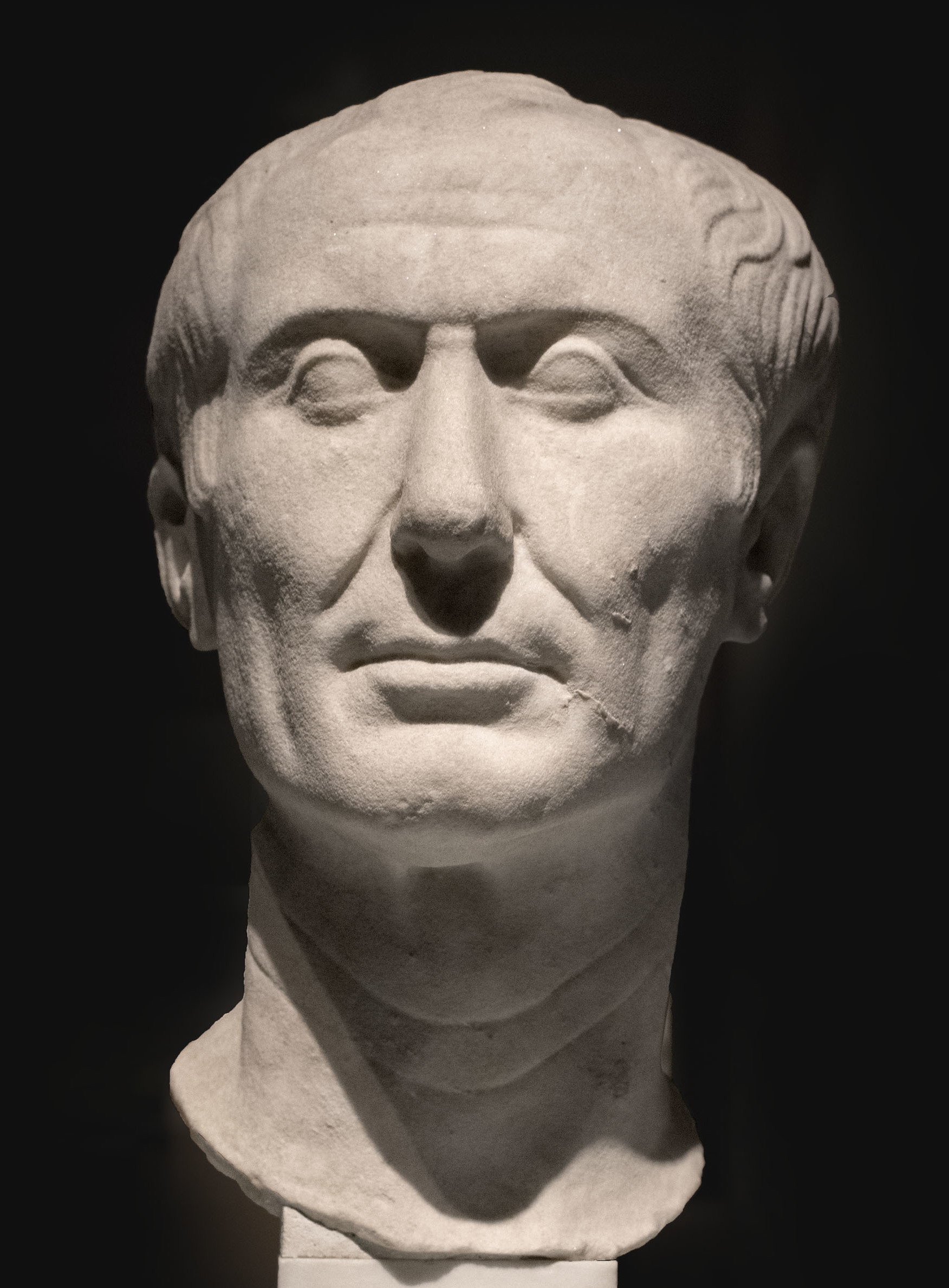
Kidnapped and held for ransom, the young Caesar told his captors exactly what he would do to them once freed. They thought it was a joke. It was not a joke.
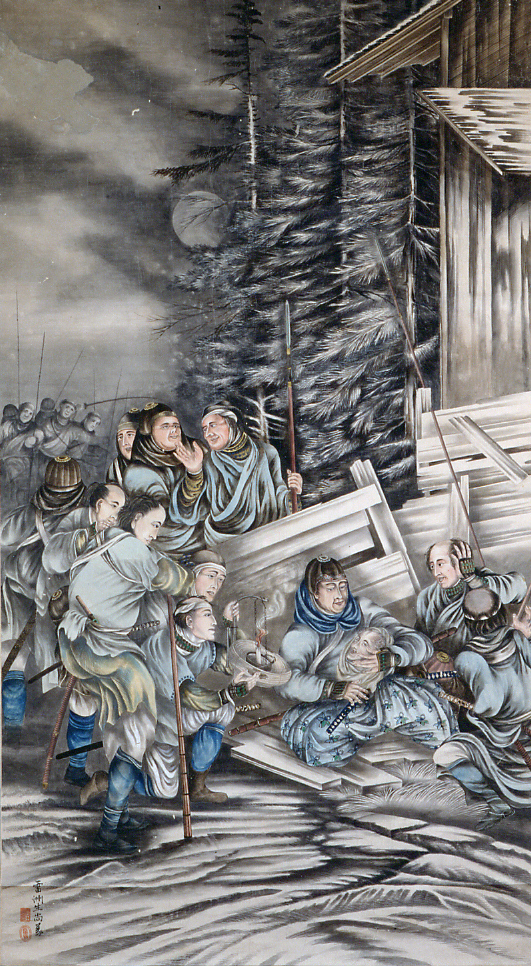
Their master was forced to kill himself over an insult. His samurai waited almost two years — playing the part of broken, drunken failures — before they struck.