
RevengeIdeas
Served Cold
Her husband had tried to buy his family's safety by naming Rome his heir. Rome answered by seizing everything, flogging the widowed queen in public, and raping her daughters. The Iceni queen answered with fire.
When the legions of Claudius came ashore in 43 AD, the conquest of Britain was not a single battle but a patchwork of bargains. Some tribes were beaten into submission; others were bought. Among those who chose accommodation over annihilation were the Iceni, a people of the flat, rich country of what is now Norfolk and Suffolk. Their king, Prasutagus, became a client ruler — nominally sovereign, allowed his crown and his customs, but bound to Rome and dependent on Roman goodwill. It was a familiar arrangement on the edges of the empire. The client king kept order, paid his dues, and in exchange Rome left his throne standing. The understanding, never written but always present, was that the arrangement lasted exactly as long as Rome found it convenient. Prasutagus seems to have understood the precariousness of his position better than most. The Iceni were wealthy. They were also, in Roman eyes, a temporary fixture.
When the king fell ill and faced his death, he tried to do the one thing a careful man could do to protect what he left behind: he drafted a will. By its terms, he named the Roman emperor — then Nero — as co-heir alongside his two daughters. The logic was the logic of appeasement. By handing Rome a generous share of his estate and his kingdom, he hoped to satisfy imperial greed and leave enough for his family to live as nobility under continued Roman protection. It was a calculated act of submission, and it failed completely. The Roman historian Tacitus, writing within a generation or two of the events and the most important source we have, records the king's reasoning plainly: Prasutagus hoped that by this show of deference his kingdom and household would be kept free from injury. Tacitus adds, with the dry fatalism that marks his account, that the outcome was the opposite. A will that tried to divide a kingdom between an emperor and two girls was, to the men on the ground, simply an invitation. Rome did not recognise client kingdoms as inheritable property in the first place. To the procurator and the officials who descended on the Iceni after the king's death, the territory was not a bequest to be honoured but a windfall to be seized whole.
What followed is the part of the story that has never lost its power to appal, and it is worth stating plainly because the rest of the revenge is unintelligible without it. According to Tacitus, the kingdom was plundered by centurions and the king's own household by slaves, as if the whole had been handed over as spoils of war. The Iceni nobility were stripped of their ancestral estates. The relatives of the dead king were treated as slaves. And then, at the centre of it, the two acts that turned a political grievance into a war: Boudica, the king's widow and queen, was publicly flogged — scourged like a criminal or a slave — and her two daughters were raped. The detail of the flogging matters. This was not a private cruelty but a deliberate, public humiliation of a queen, carried out before her people. In a society that took rank and the honour of its women seriously, the message was unmistakable: the Iceni royal line was not noble, not protected, not even free, but chattel to be whipped and violated at Roman pleasure. The assault on her daughters compounded it past any hope of repair. There was a separate fire burning elsewhere in the province, too. To the south, at Camulodunum — modern Colchester, the former Trinovantian capital turned Roman colony — retired legionaries had driven the locals off their land and a temple to the deified Claudius rose over them, which Tacitus says the Britons regarded as a citadel of eternal domination, its upkeep a ruinous tax. Boudica did not have to manufacture grievances. She only had to give them a leader.
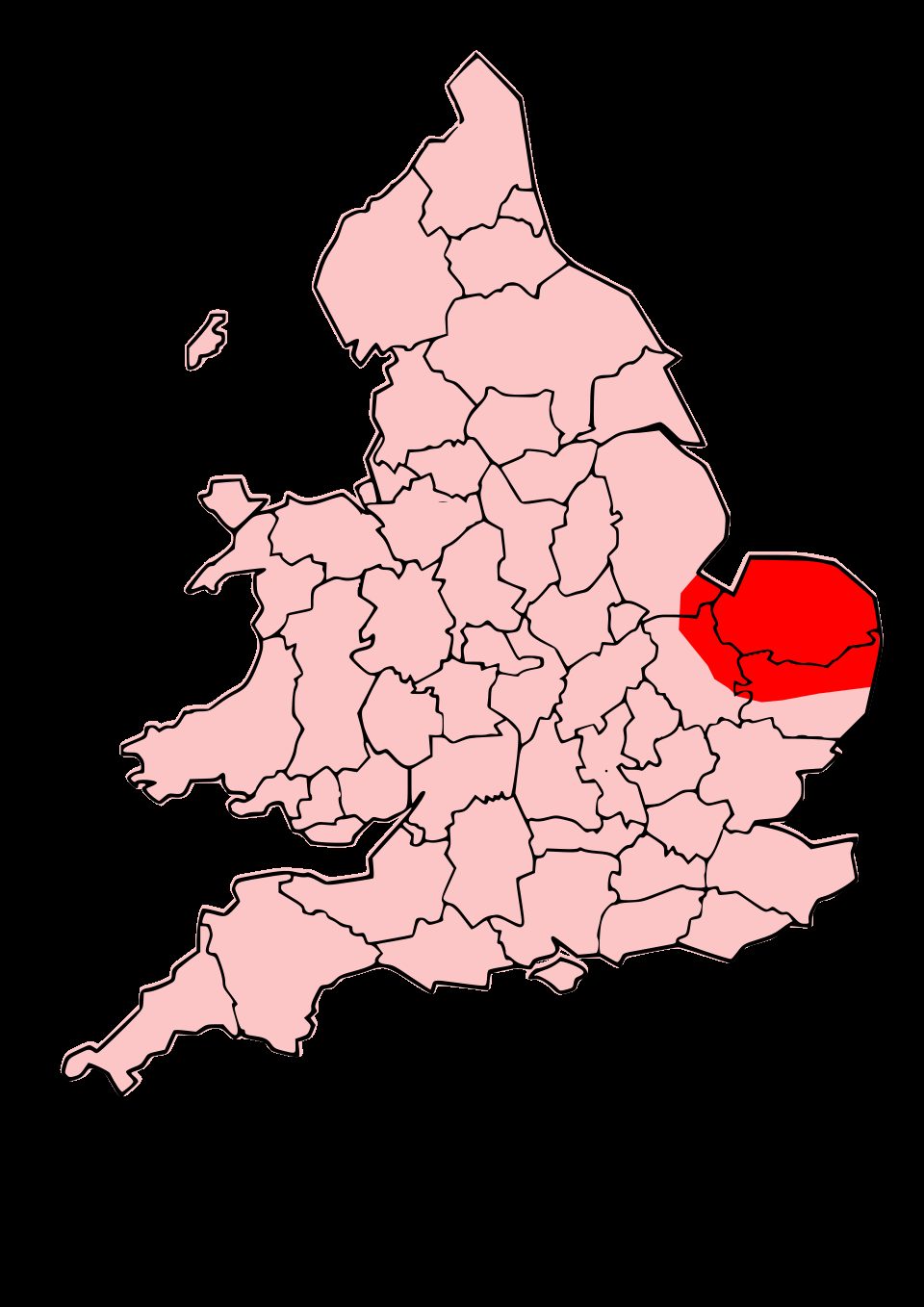
Revenge requires opportunity as much as motive, and in 60 or 61 AD opportunity arrived. The Roman governor of Britain, Gaius Suetonius Paulinus, an ambitious and capable soldier hungry for a victory to match his rivals, had marched the bulk of the province's military strength to the far northwest. His target was the island of Mona — Anglesey — a centre of Druidic resistance and a refuge for fugitives. With the legions hundreds of miles away on the Welsh coast, the southeast of Britain, with its undefended colony and its raw, half-built towns, lay effectively open. Boudica gathered the Iceni and was joined by the Trinovantes and others who had their own scores to settle. Tacitus and the later historian Cassius Dio both describe a host of enormous size — Dio's figures run to the hundreds of thousands and are surely inflated, but the scale was unquestionably vast, large enough to overwhelm anything the Romans could quickly assemble against it. The waiting was over the moment the legions turned their backs.
The army fell first upon Camulodunum. The colony had no walls — the veterans had not thought to build any, confident in Roman invincibility — and only a small garrison. Tacitus records that the colonists, unnerved by omens that local feeling read as portents of doom, sent to the procurator Catus Decianus for help and received barely two hundred ill-equipped men. The town was overrun. The remaining defenders made their last stand in the great temple of Claudius, the very monument the Britons hated most, and held out for two days before it was stormed and they were slaughtered to the last. The colony was burned to the ground. Archaeology has confirmed the violence of that day with unusual precision. Excavations beneath modern Colchester reveal a thick layer of scorched red and black destruction debris — the so-called Boudican destruction horizon — burnt grain, melted glass, fire-cracked walls, the carbonised remnants of a Roman town consumed in a single catastrophe. Then came the reckoning's second stroke. The Ninth Legion, under Quintus Petillius Cerialis, marched south to relieve the colony. Boudica's army met it on the road and destroyed it. The entire infantry force was cut down; Cerialis escaped with only his cavalry and fled to his fortified camp. A Roman legion, the instrument of the empire's dominance, had been shattered in open country by the people it was meant to hold down.
The procurator Catus Decianus, whose greed and misrule had done so much to ignite the revolt, fled across the sea to Gaul. Suetonius Paulinus, hearing of the disaster, made a forced march back across the province ahead of his army and reached Londinium — London, even then a thriving merchant town — before the rebels. He found it indefensible. In one of the coldest decisions in the record, he chose to sacrifice the town to save the campaign, withdrawing his small escort and abandoning the inhabitants to their fate. Tacitus writes that those who stayed behind, the old, the weak, and those simply attached to the place, were overwhelmed by the enemy. Londinium was burned as Camulodunum had been, and here too the spade has confirmed the text: a distinct red layer of burnt clay and ash runs beneath the modern City of London, the fingerprint of the same fire. The third city, Verulamium — modern St Albans, a town of Britons who had thrown in their lot with Rome — met the same end. Three towns, three columns of smoke. Tacitus puts the dead across the three at around seventy thousand, Roman citizens and their provincial allies, and describes a campaign that took no prisoners and showed no interest in the slow profit of slavery. Dio, with grim relish, describes atrocities committed on the captured. Whatever the exact figures, the queen who had been flogged had now burned the heart out of Roman Britain.
Revenge, even great revenge, is not the same as victory, and Boudica's ran out at the last. Suetonius Paulinus regrouped his forces — the Fourteenth Legion, detachments of the Twentieth, and what auxiliaries he could gather, perhaps ten thousand men against a host many times larger. He chose his ground with care: a defile or narrow valley, the historians say, with a forest at his back to prevent encirclement and an open plain in front across which the Britons would have to charge. The exact site is unknown; tradition and argument have placed it everywhere from the Midlands to Mancetter in Warwickshire, but no battlefield has ever been confirmed. Tacitus gives both commanders speeches before the clash — set-pieces in the ancient manner, not transcripts, but telling. He has Boudica ride before her people in her chariot with her violated daughters before her, declaring that she fought not as a queen for her kingdom but as one of the people for her lost freedom and her outraged body, and that the gods were on the side of a just revenge. Whatever she truly said, the battle went against her. The British numbers, packed into the narrow ground, became a liability; the disciplined Roman line held, then advanced in a wedge. The Britons broke, and their flight was blocked by the very wagons they had drawn up at the rear with their families aboard to watch the expected triumph. The slaughter that followed fell on warriors, women, and baggage animals alike. Tacitus records a Roman casualty list so lopsided as to be propaganda, but the result is not in doubt. Boudica's revolt died on that field.
Boudica did not survive her defeat. Tacitus says she ended her own life by poison rather than fall into Roman hands; Dio reports instead that she fell ill and died, and was given a costly burial by her people. Either way she passed out of the record within weeks of the battle, and her grave has never been found. What followed was a punitive devastation of the Iceni and their allies, a hard winter of reprisal and near-famine as the Romans laid the territory waste. It was severe enough that even Rome grew uneasy. Suetonius Paulinus was eventually recalled, his harshness judged to be prolonging the unrest, and a more conciliatory administration set about the slow work of pacification. The revolt had come close — closer than Rome liked to admit — to ending the occupation of Britain entirely. For a few weeks in 61 AD, the province had hung by a thread.
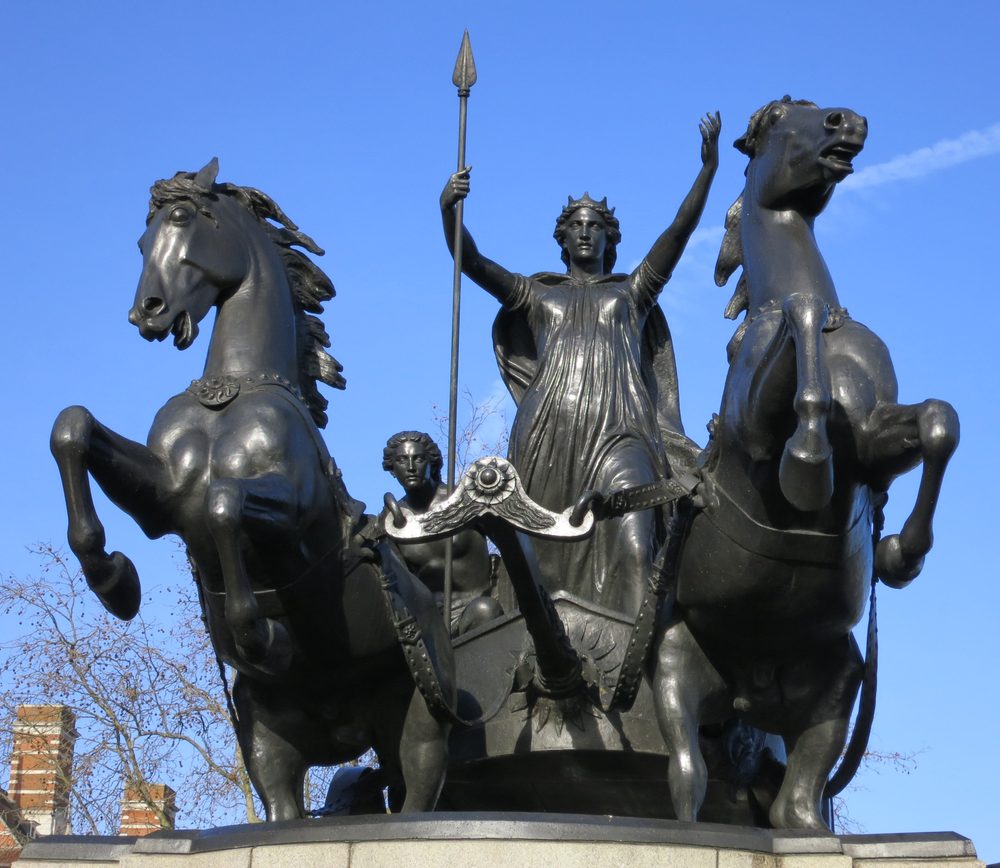
Then the memory of her vanished for the better part of fifteen centuries. The Britons left no written history of their own, and the Roman sources that preserved Boudica were lost to medieval England. She returned only with the rediscovery of Tacitus in the Renaissance, and from there her legend grew with strange momentum. The Elizabethans, ruled by a warrior queen of their own, found in her a useful ancestor. By the nineteenth century she had become an icon of the very empire she had fought — Victorian Britain, the largest empire the world had seen, adopted the queen who burned Roman cities as a national heroine, helped along by the happy accident that the name Boudica derives from a Brittonic word for victory, and by Tennyson's verse and a wave of patriotic art. The most enduring monument came in 1902, when Thomas Thornycroft's great bronze, Boadicea and Her Daughters, was raised on the Victoria Embankment beside the Palace of Westminster. It shows the queen standing tall in a scythe-wheeled war chariot, spear raised, her two daughters beside her, the horses rearing — driving, as it happens, straight toward the seat of British government, on the bank of the same river beside which she once burned a Roman town to ash. Historians still debate how much of Tacitus to believe and how much is the shaping of a moralist who wished to shame his own countrymen with the dignity of a barbarian queen. But the bones of it hold. Rome flogged a widow and assaulted her children to save the cost of honouring a dead king's will, and the bargain it refused to keep cost it three cities, a legion, and seventy thousand lives. The arithmetic of that revenge has never quite balanced, and Britain has never let it be forgotten.
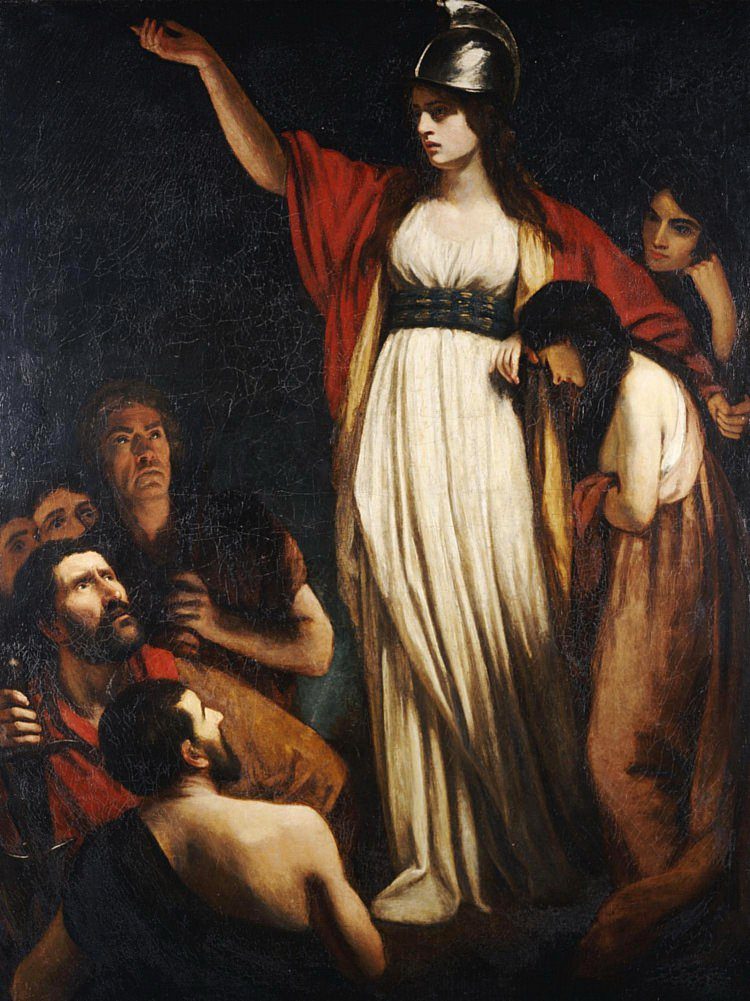
Image: John Opie, "Boadicea Haranguing the Britons" (1793). Public domain, via Wikimedia Commons.
Rome filed her under catastrophe. Britain remembered her as a queen, and cast her in bronze beside the Thames — chariot, daughters and all — staring straight at the seat of the empire she nearly drove out.
They killed her husband, then sent ambassadors to ask her to marry their prince. She welcomed them warmly — and erased their entire people in four escalating acts of horror.
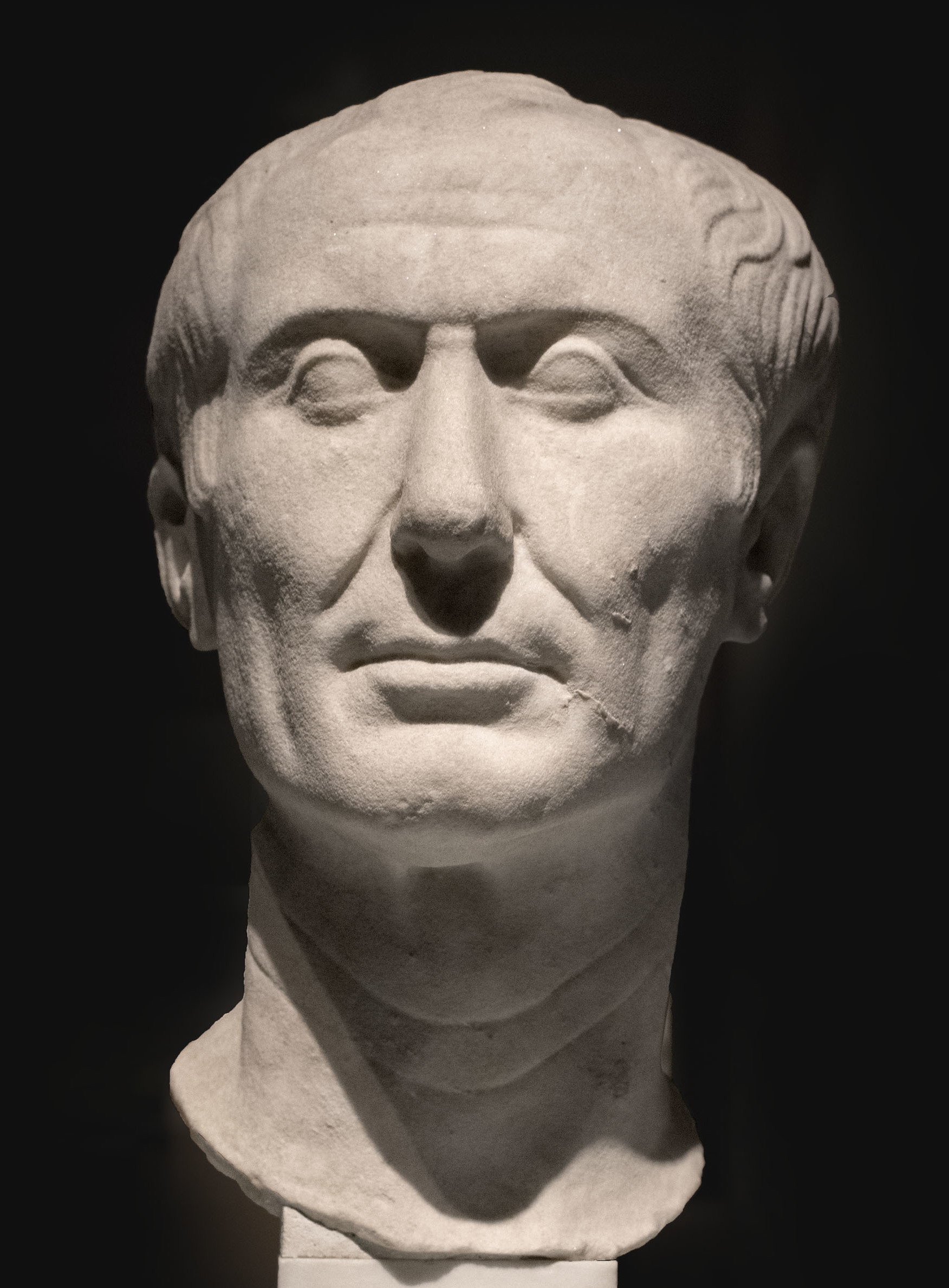
Kidnapped and held for ransom, the young Caesar told his captors exactly what he would do to them once freed. They thought it was a joke. It was not a joke.